Ready to transform your hiring?Your next great hire is waiting.
Your next great hire is waiting.
Let AI find them.
Join engineering teams who replaced week-long hiring cycles with hours. No credit card required.
Join engineering teams who replaced week-long hiring cycles with hours. No credit card required.
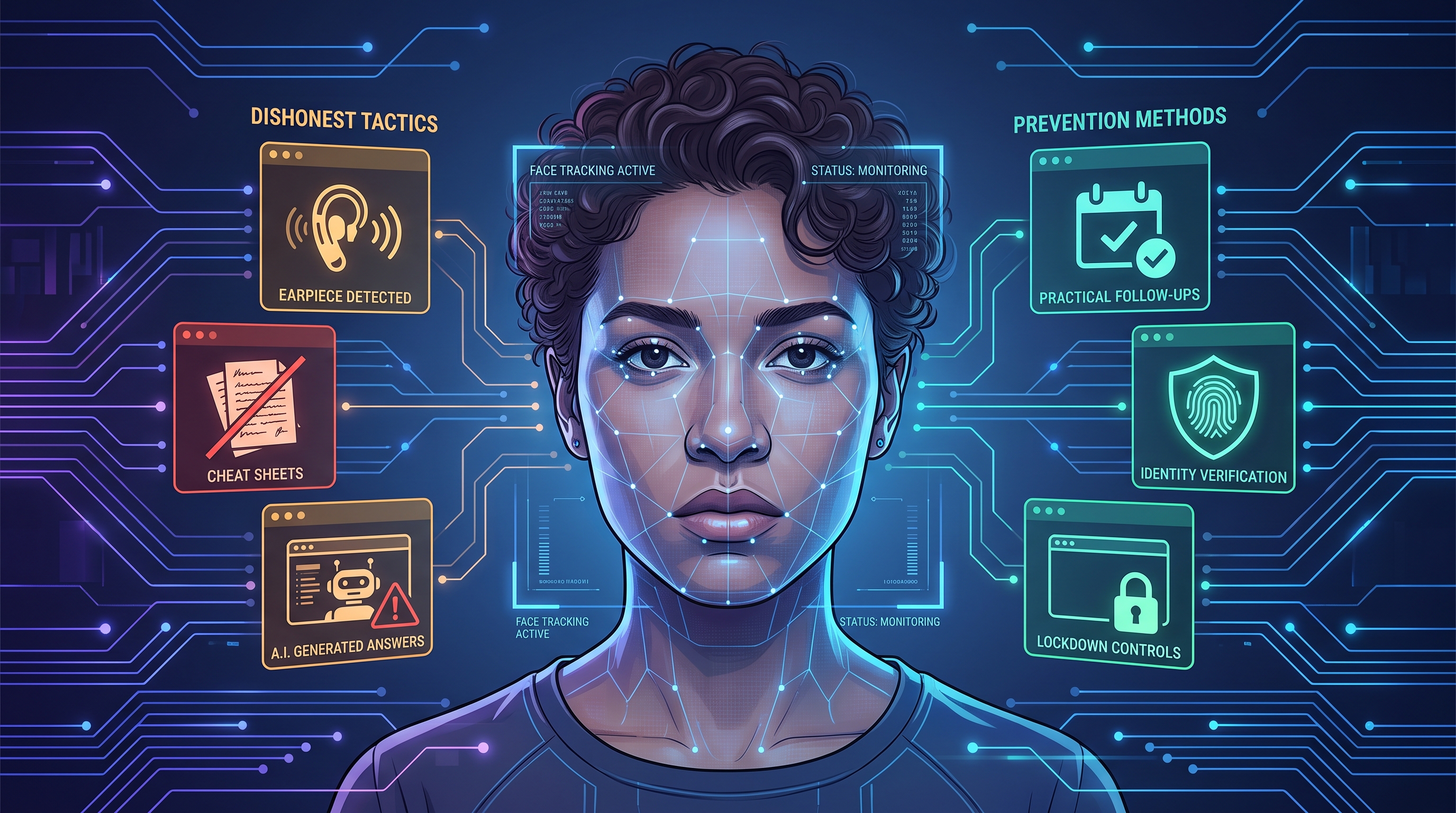
Remote screening saves time, but it opens the door to dishonest tactics. Applicants now use dual monitors, hidden browser tabs, earpieces, and real-time AI tools to feed them answers. If you want to know how to prevent cheating in remote video interviews, the solution comes down to three steps: design dynamic questions that cannot be read from a script, enforce proctoring controls that detect suspicious behavior, and verify claims with practical follow-ups.
Catching dishonest behavior protects your team. It keeps unqualified applicants from slipping into final rounds, saves hours of wasted engineering interviews, and ensures a fair process for honest candidates.
Here is how to stop cheating before, during, and after remote interviews.
To stop interview fraud, you have to know what you are looking for. Remote candidates rarely use simple cheat sheets anymore. Modern tactics are subtle and often run quietly in the background.
Recognizing these methods helps you spot the warning signs during the conversation.
Cheating creates unnatural physical patterns. While nerves can cause odd behavior, repeated patterns usually indicate that an applicant is receiving outside help.
Watch where the candidate looks. If someone constantly glances to the bottom-left or top-right before answering every question, they are likely reading off a second screen or reading live AI output. Candidates reading a screen tend to move their eyes horizontally across short lines of text.
When you ask an unexpected question, a normal candidate pauses, says "let me think," and speaks with casual imperfections. A candidate using AI tools will often stay silent or repeat the question aloud to let their speech-to-text engine process it. Then, they deliver an overly formal, textbook answer that sounds like documentation rather than lived experience.
Listen closely for mechanical keyboard typing while the candidate is supposedly looking directly at you. Watch for slight delays between lip movements and spoken audio, which can signal a proxy speaking over the stream.
Software helps, but interview design is your first line of defense. If your questions rely on textbook definitions, candidates can look up answers in five seconds. Change how you ask questions to make scripts useless.
Generic questions invite generic answers. Instead of asking "How do you handle a slow database query?", ask: "Tell me about a specific database index you built that caused an unexpected issue in production, and how you solved it."
Fraudulent candidates and AI engines struggle with messy, real-world context. They can describe best practices, but they cannot invent deep, consistent details about personal mistakes on the fly.
A prepared script falls apart under rapid follow-ups. When an applicant gives an answer, do not simply move to the next item on your rubric. Interrupt politely with immediate follow-ups:
Candidates reading from a generated prompt will freeze or dodge the question, because their cheat tool cannot anticipate conversational interruptions.
One-way video forms, where a candidate records an answer to a static prompt, are easy to game. Candidates can rehearse, read teleprompters, or record multiple takes. Live voice interviews force spontaneous thinking. Every candidate must think out loud, revealing their true communication skills and depth of knowledge.
Process changes help human interviewers, but high-volume pipelines need automated safeguards. Screening hundreds of applicants manually takes too much recruiter time.
Modern proctoring uses several technical layers to preserve hiring integrity:
Using technical proctoring does not mean treating every applicant like a suspect. It creates a standardized, fair environment where honest applicants are evaluated on their true merits.
Balancing security and candidate experience is critical. If your screening process requires invasive system downloads or invasive surveillance software, top performers will abandon the application.
To keep the experience respectful:
Preventing interview fraud does not require your engineering managers to spend hours conducting basic phone screens. By combining spontaneous, dynamic questions with automated proctoring, you can screen candidates at scale and shortlist the best fit with confidence.
If you want to automate early-stage screening without sacrificing integrity, consider AiHire.io. AiHire.io is an AI interviewer that conducts live, voice-to-voice interviews with candidates out loud. It asks natural follow-up questions, detects cheating through browser lockdown and real-time face detection, and provides ranked scorecards with clear proctoring proof. You can review the top 5 candidates quickly, save hours of screening time, and hire faster.
The most common method is using a second monitor or split screen running real-time generative AI tools. Speech-to-text software transcribes the interviewer's question, and an AI model generates an answer for the candidate to read off-screen.
Look for horizontal eye tracking across the screen, unnatural pauses where the candidate repeats your question to feed their software, and answers that sound like formal documentation rather than conversational speech.
No tool can stop 100% of cheating, but browser lockdowns, face tracking, and tab-focus monitoring stop common tactics like searching answers, copying text, or having a second person in the room.
No. One-way asynchronous video recordings are among the easiest formats to cheat because candidates can use off-screen teleprompters, script their answers, or take unlimited time between prompts to look up information.