Ready to transform your hiring?Your next great hire is waiting.
Your next great hire is waiting.
Let AI find them.
Join engineering teams who replaced week-long hiring cycles with hours. No credit card required.
Join engineering teams who replaced week-long hiring cycles with hours. No credit card required.
Technical recruiting is caught between two bad options. On one hand, senior engineers spend 10 to 20 hours every month each conducting repetitive 30-minute phone screens. On the other hand, asynchronous video forms or generic multiple-choice quizzes alienate quality developers and invite widespread cheating.
Adopting ai voice interview software for technical screening bridges this gap. It replaces static questionnaires and initial phone calls with an interactive, spoken conversation that assesses technical reasoning, system design basics, and communication skills before a candidate ever meets your engineering team.
Here is how modern voice screening works for technical roles, what features matter most, and how to evaluate these tools effectively.
The initial screening stage for technical hires is broken in three distinct ways:
Voice-based AI interviews solve these issues by conducting a real-time conversation. Instead of playing pre-recorded prompts, the system speaks to the candidate, listens to their answer, and asks context-aware follow-up questions.
Unlike text-based assessments, voice screening evaluates how an engineer thinks on their feet. The software uses large language models that understand technical concepts, frameworks, and architectural jargon.
When a candidate explains an approach, the system processes the audio in real time. If the candidate gives a shallow or textbook definition, the voice interviewer can ask: "How would that pattern handle database connection pooling under high concurrency?" or "What are the trade-offs between that approach and an asynchronous message queue?"
This dynamic back-and-forth makes rehearsed answers and prompt-reading obvious. A candidate who genuinely understands a system can explain their reasoning, while someone reading a script will struggle when pressed for specific implementation details.
Not all automated interview tools can handle technical roles. When evaluating software for developer and technical screening, focus on these capabilities.
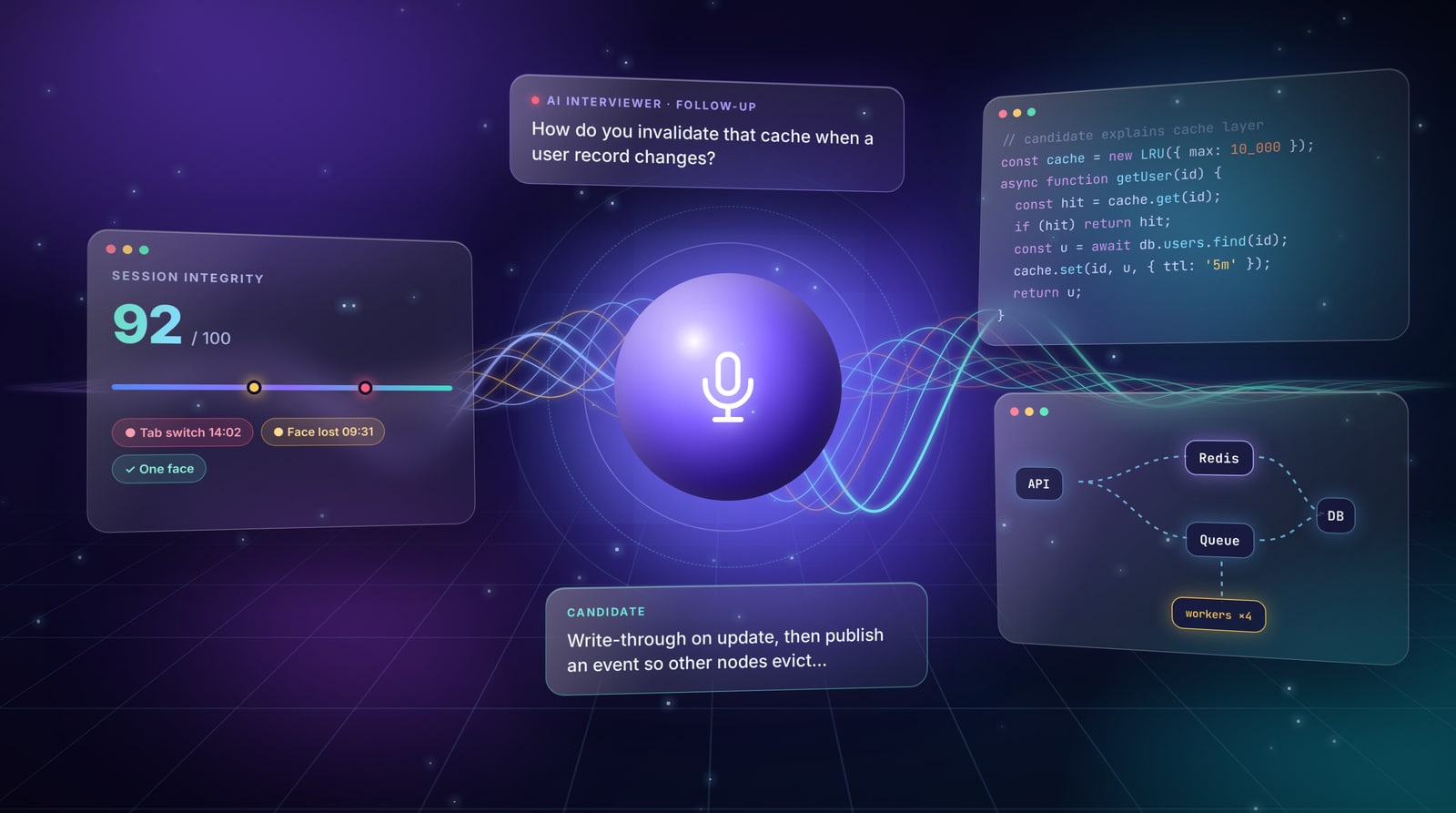
Static interview scripts are easy to game. The primary value of an AI voice interviewer is its ability to probe deeper based on what the candidate just said. If an applicant mentions using Redis for caching, the system should follow up on eviction policies or cache invalidation strategies relevant to the role.
Technical screens must protect hiring integrity. Look for tools that log tab switches, block copy-paste, flag when the candidate's face leaves the frame or a second face appears, and catch head movements that suggest reading from another screen. The system should document timeline flags directly on the recording so hiring managers can jump to the exact moment and verify whether a candidate paused to look up an answer. For a deeper look at interview integrity, read our guide on how to prevent cheating in remote video interviews.
A voice interview feels unnatural if there is a three-second delay between the candidate finishing their sentence and the AI responding. Low latency is critical to keeping the conversation flowing smoothly, especially when discussing complex technical workflows.
Hiring teams should not have to listen to every minute of every call. The software should generate structured reports covering technical knowledge, communication, and problem-solving, with feedback that cites specific moments from the transcript. The full recording and transcript should sit alongside the score, so recruiters can check the evidence rather than trust a vague percentage.
When you begin comparing vendors, avoid getting distracted by flashy feature lists. Focus on how well the platform serves both your hiring team and your candidates.
Engineers will abandon clunky interview processes. Test the candidate interface yourself. Does it require downloading extra desktop software, or does it run directly in the browser? Is it clear what the candidate needs to do before the interview starts? A seamless, frictionless experience keeps completion rates high.
Every engineering team has a distinct tech stack and architectural philosophy. Your screening tool must allow you to set custom interview questions, difficulty, and focus areas tailored to your exact requirements, whether you are hiring a distributed systems engineer, an iOS developer, or an SRE. The AI must understand niche terminology and avoid penalizing candidates who describe valid alternative approaches.
Many legacy hiring platforms lock companies into expensive annual subscriptions with seat fees for every recruiter and hiring manager. This model punishes growing startups and companies with fluctuating hiring needs. Look for usage-based pricing where you pay only for the interview minutes you actually use, allowing you to scale up or down based on your hiring volume.
To get the best data from an AI voice interview, you must design your questions thoughtfully. Avoid asking for memorized syntax or trivia that any developer could look up in documentation. Instead, focus on:
By focusing on decisions, trade-offs, and debugging methodology, an AI voice screen quickly separates hands-on builders from superficial candidates.
Automating first-round phone screens does not mean sacrificing interview quality. By replacing cold forms with an intelligent, spoken dialogue, engineering teams save hours of senior engineering time every week while screening every applicant fairly and consistently.
If you want to screen candidates with live AI voice interviews that ask real-time follow-ups and catch cheating, try AiHire.io with $100 in free hiring credits.
Yes. While it does not replace a live coding environment for final rounds, voice screening effectively assesses conceptual knowledge, architectural trade-offs, debugging logic, and communication skills before technical teams invest time in live pair-programming sessions.
The software monitors browser tab switching, copy-paste events, audio anomalies, and unnatural response delays. It flags moments where a candidate may be reading generated answers or receiving off-screen assistance, linking evidence directly to the interview timeline.
Most candidates prefer interactive voice interviews over one-way video recordings. A responsive voice dialogue feels like an actual technical screening call, allows applicants to explain their thought process, and lets them complete the screen on their own schedule.
No. It replaces the initial recruiter phone screen and early technical filtering. The goal is to deliver a verified, ranked shortlist of top candidates to your engineering team so senior developers only spend time interviewing qualified applicants.